Pages

Sunday, September 20, 2009

Samurai-kabuto


   This is helmet "Hikiyama of Kenshin Uesugi"
of the tenth Karatsu Kunchi.

   Uesugi Kenshin (上杉 謙信,1530-1578) was a daimyo

" Samurai " Semi-cursive script


   "侍" (samurai) It is translated as samurai.Semi-cursive script


   What is
"Bushido"? The knowledge is written in"Hagakure".

   Hagakure says that "Bushido is to die" in the beginning.

   But It is do not merely die, and it is to live in a way to one's aim thoroughly.


   When it is "Bushido" to live in every day with strong-willed will like it.

   It is written ironically.


   The great samurai, Ōta Dōkan created the phrase of the death poem.

     かかる時さこそ命の惜しからめ  かねてなき身と思い知らずば
       太田道灌 (1432 - 1486)

     When I am like this, I don't think my life to be precious so much.
      Because I already recognized that there wasn't my life anymore, and I had lived.
       
Ōta Dōkan (1432 - 1486)

   He was the too superior samurai.
   Therefore his lord assassinated him.

   The great samurai gave the life of his own to fate.
   The soul is holy.

   Yes, it may be surely cruel.
   However, the ancestor succeeded to the Japanese spirit (
Yamato-damashii) as beauty.

   We descendant will never forget it.

Saturday, September 12, 2009

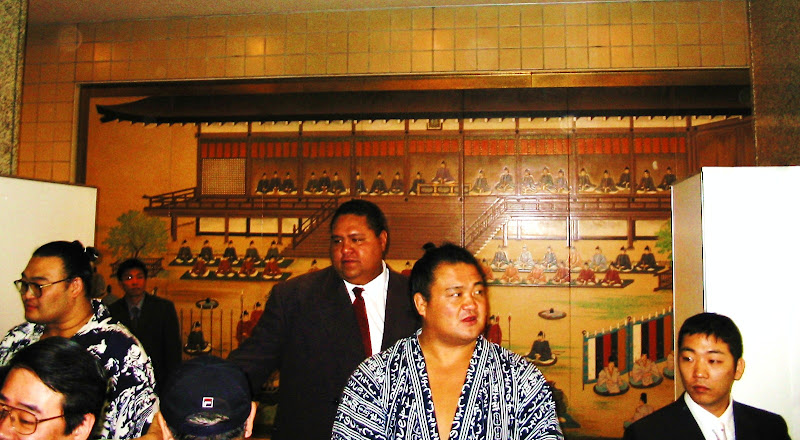
"Sumō" practice doing in a spectators presence.


All sumō wrestlers must practice attracting it in front of a spectator with a boss just before a regular sumō tournament.

The position is the lowest them begins with about 04:00 a.m, and a "Yokozuna"and an "Ōzeki" practice last at about 10:00 a.m.

This is called "Keiko-Sōken" meaning "watch an exercise with all the members".
The greatest boss teaches it in the immediate left of the sumo ring.
There are the other bosses around.
It is shame to have weak pupil for a boss.


The sumō wrestler won appoints the next partner till he lose and can practice.
If they lost, they must step forward immediately so that it is appointed.
If they cannot do so that to not positive , cannot practice forever.
A yokozuna and the ōzeki attach a white "mawashi", and the other are black.

At the time of exercise of a yokozuna and the ōzeki, the other must watch it outside a sumō ring until the end.

It is Takanohana II to attach a white mawashi.
It very felt honored that could practice with him for sumo wrestlers.
There is not his dignified sumo wrestler after him at all.


A yokozuna and the ōzeki can wipe sweat.
Only the yokozuna can have an assistant wipe sweat.
Because they clash many times, the whole body is muddy,and most bleed.

The practice is much more severe than the match.
The sumo is the world of a very strict "The man".


When an exercise is over, the popular sumō wrestler sees off a spectator while shaking hands.

Even if "Yokozuna-Akebono (a suit figure)" retire himself, it was popular very much.
He was very very gentle,tender-hearted "The man".


"Daidozan Peforming the Ring Entering Ceremony" Tōshūsai Sharaku (東洲斎写楽 1794 - 1795)
It is tradition, and sumo is art.

Please have a good weekend all of you.

Wednesday, September 9, 2009

Sky Watch to Mt. Fuji


   Mount Fuji (富士山,Fuji-san) is the highest mountain in Japan at 3,776 m (12,388 ft).


   I photographed these right before landed at Haneda Airport.
   The telephoto lens of my compact camera could catch that thinly.

   It is Tokyo Bay that see below.

Sunday, September 6, 2009

Another world in the other side of the gate


This gate "Karamon" built in 1599 is a national treasure.


One more gate, the world that can meet Buddha spreads out.


This Five Storeyed Pagoda is built in 951,

It is a temple having the very large precincts more than 6,600,000 square meters in the Kyoto Fushimi-ku Mt. Daigo spreading east.
It developed as hallowed ground of many mountaineering ascetics.
The portrait of "Kūkai" exists is oldest.


It is difficult even to imagine the front now more than 1000 years.
"Immemorial Time"